Equipment
เสื้อชูชีพ
Lifejacket
Symbol per the LSA Plan
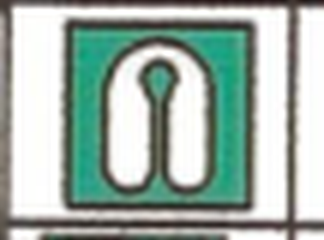
Symbol per the LSA / Fire Control Plan · IMO Res. A.760(18)
Wherever this symbol appears on the plan, this equipment is installed at that spot
Technical requirements (LSA Code 2.2)
This content comes from OCR text extraction
The text may contain inaccuracies, especially units and clause numbers. Treat the original scanned pages or the official IMO document as authoritative.
General requirements for lifejackets
A lifejecket shall not sustain buming or continue melting after being totally enveloped in a fire fora pernod of 2 s.
Lifejackets shall be provided in three sizes in accordance with table 2.1. Wf a litejacket fully complies with the requirements of two adjacent size ranges, it may be marked with both size ranges, but the specified ranges shall not be divided. Lifejackets shall be marked by either weight or height, or by both weight and height, according to table 2.1.
If an adult litejacket is not designed to fit persons weighing up to 140 kp and with a chest girth of up to 1,750 mm, suttable accessones shall be available to allow it to be secured to such persons. Table 2.1 — Lifejacket sizing cnteria __Nifejacket marking | infant hits | dt Liwer’s sie Werght (kg) Less than 15 15 or more but hess than 44 43 of more Iheyght (cm) Less than 100 10 of more but hess than 155 =| 155 of more
The in-water performance of a lifejacket shall be evaluated by comparison to the perionmance of a suitable size standard reference lifejacket, Le. reference test device (RTD) complying with the recommendations of the Organization.”
An adult litejacket shall be so constructed that: oat least 75% of persons who are completely unfamiliar with the litejacket can correctly don it within a penod of 1 min without assistance, puidance or prior demonstration; 2 alter demonstration, all persons can correctly don it within a period of 1 min without assistance: 3 it is dearly capable of being worn in only one way or inside-out and, if donned incorrectly, it is not myunous to the wearer; 4 the method of securing the lifejacket to the wearer has quick and positive means of closure that do not require tying of knots; - itis combortable to wear, and «6 sit allows the wearer to jump into the om a height of at beast 4.5 m while holding on to the biejacket, and from a height of at beast ith arms held overhead, without injury and without dislodging or damaging the lifejacket Grits attachments.
When tested according to the of the Organization on at least 12 persons, adult litejackets shall have sufficient Cae in calm fresh water to: lo lift the mouth of exhausted Gru ious persons by an average height of not less than the: average provided by the adult RTD minus 10 mm; -2 tum the body of unconscious, face-down persons in the water to a position where the mouth is lear of the water in an average time not exceeding that of the RTD plus 1s, with the number of persens not turned by the litejacket no greater than that of the RTD; 3) incline the body backwards from the vertical position for an average torso angle of not less than that of the RTD minus 10°; 4 sift the head above honzontal for an average faceplane angle of not less than that of the RTD minus 10°: arc 5 retum at least.as many wearers to a stable face-up position alter being destabilized when floating in the flexed foetal position’ as with the RTD when tested on the wearers in the same manner.
An adult hiejacket shall allow the person wearing it to swim a short distance and to board a survival craft.
An iniant of child lifejacket shall perform the same as an adult lilejacket exoept as folhows: 1 donning assistance is permitted for small children and infants; -2 the appropriate child or infant RTD shall be used in place of the adult RTD: . Rejer to the Revised recommendation on testing of lite saving anpfiances (resolution MS 81 (70), as amended). * Reder to the dlustration on page 9 of the IMO) Pocker Garde for Cold Water Survival, 2012 Edition, and in the Revised recommendation an testing of ife-saving appliances (resolution MSC_B1(70), as amended. 3 assistance may be given to board a survival craft, but wearer mobility shall not be reduced to any greater extent than by the appropriate size RTD; 4 for infants the jump and drop tests shall be exempted; 5 for children, five of the nine sulyects shall periorm the jump and drop tests; and 4 in kew of paragraph 2.2.1.8.5, manikins may be substituted jor human test subjects.
With the exception of freeboard and seli-nghting periormance, the requirements for infant lifejackets may be relawed, if necessary, in order to: J facilitate the rescue of the infant by a caretaker; -2 allow the infant to be fastened to a caretaker and contribute to keeping the infant close to the caretaker, 3 keep the infant dry, with free respiratory passapes; 4 protect the infant against bumps and jolts during evacuation; and 4 allow a caretaker to monitor and control heat boss by the infant.
= In addition to the markings required by paragraph 1.2.2.9, an infant or child lifejacket shall be marked wath: J othe size range in accordance with paragraph 2.2.1.2; and 2 an “infant” of “child” symbol as shown in the “infant's litesjacket” or “child's litejacket” symbol
A lifejacket shall have buoyancy which is not reduced by more than 5% alter 24 h submersion in fresh water. pes 2.24.12 The buoyancy of a lifejacket shall not depend on the use of loose granulated materials
| a ee ee eee paragraph 2.2.3 that it shall be capable of complying with paragraphs 2.2.1.5.6 and 2.2.3.1.3.
Each liiejacket shall be fitted with a whistle firmly secured by a lanyard.
Lifejacket lights and whistles shall be selected and secured to the litejacket in such a way that their performance in combination is not degraded.
A lilejacket shall be provided with a releasable buoyant line or other means to secure it to a lifejacket worn by another person in the water.
_ A litejacket shall be prowded with a suitable means to allow a rescuer to lift the wearer from the water into a survival craft of rescue boat.
Inflatable lifejackets A lifejacket which depends on inflation for buoyancy shall have not bess than two separate compartments, shall comply with the requirements of parapraph 2.2.1 and shall: 1 inflate automatically upon immersion, be provided with a device to permit inflation by a single manual motion and be capable of having each chamber inflated by mouth; 2 in the event of loss of buoyancy in any one compartment be capable of complying with the requirements of paragraphs 2.7.1.5, 2.7.1.6 and 2.2.1.7; and * Rejer to Symbols related to iie-saving appliances and arangements iresolution A.760418), as armended by resolution MSC_B2(7 01). 3 comply with the requirements of paragraph 2.2.1.1) after inflation by means of the automatic mechani.
Lifejacket lights
Each litejacket lipht shall: JA have a luminous intensity of mot bess than 0.75 cd in all directions of the upper hemisphere; 2 have a source of energy capable of providing a luminous intensity of 0.75 od for a period of at least & h: 3) be visible over as great a segment of the upper hemisphere as is practicable when attached to a litepacket; and 4 be of white colour.
li the light referred to in paragraph 2.2.3.1 is a flashing light, it shall, in addition: 1 be provided with a manually operated switch; and -2 = flash at a rate of not Jess than 50 flashes and not more than 70 flashes per minute with an effective luminous intensity of at beast 0.75 cd.
Installation and quantity requirements (SOLAS Ch.III)
2Lifejackets
2.1A lifejacket complying with the requirements of paragraph 2.2.1 or 2.2.2 of the Code shall be provided for every person on board the ship and, in addition:
.1for passenger ships on voyages of less than 24 hours, a number of infant lifejackets equal to at least 2.5% of the number of passengers on board shall be provided; (MSC/Circ.808).
.2for passenger ships on voyages of 24 hours or greater, infant lifejackets shall be provided for each infant on board;
.3a number of lifejackets suitable for children equal to at least 10% of the number of passengers on board shall be provided or such greater number as may be required to provide a lifejacket for each child;
2Lifejacket lights
2.2On cargo ships, each lifejacket shall be fitted with a lifejacket light complying with the requirements of paragraph 2.2.3 of the Code.
2.3Lights fitted on lifejackets on board cargo ships prior to 1 July 1998 and not complying fully with paragraph 2.2.3 of the Code may be accepted by the Administration until the lifejacket light would normally be replaced or until the first periodical survey after 1 July 2001, whichever is the earliest.
Key figures
- Fits wearers up to
- 140 kg
- Chest girth up to
- 1,750 mm
- Light intensity*
- ≥ 0.75 cd*
- Light duration*
- ≥ 8 h*
* From OCR, not yet verified — treat the official IMO document as authoritative